



Artificial intelligence seems to have become a prominent topic in our society, so much so that it is even included in the busy agenda of the G7 summit, which is now just around the corner. This innovative technology seems to spark interests that are characterized by various interpretations, with fervent supporters on one end and others viewing it as a demagogic monster on the other. It is a topic that has inevitably also engaged the reflection of the Church, as evidenced by the text presented for the World Day of Peace on January 1, 2024, titled “Artificial Intelligence and Peace.” In this text, as previously discussed in one of my past articles, the Church demonstrates its usual caution in the face of a new technology that has pervasive potential in society, much like what happened with writing, radio, television, the internet, and now specifically with AI. Our newspaper can boast a valuable relationship with an intellectual and highly respected scientist, Professor Gabriele Andreoli, an expert in artificial intelligence to whom I have posed the questions that are known to be more controversial, at least within a segment of intellectuals connected to the Catholic Church.
Professor, what can we say about artificial intelligence?
I believe that primarily we need to define the subject matter we are talking about, in order to dispel from the beginning any confusion that may entangle our thoughts. We are talking about a confluence of methodologies and systems, so it is necessary to start thinking that there cannot be omniscience because there is no single central system that knows everything. We must perceive ourselves as human beings incapable of possessing omniscience, as we ourselves are a complex adaptive system and at the same time we are also part of a complex adaptive system. So under the umbrella of “artificial intelligence” there is the coexistence of various systems that come together. The important question now is to define a code with which we can share and use this artificial intelligence ethically for the benefit of humanity. It is necessary to be able to define through sharing projects, analysis, study, research, and development of tools to put in the hands of legislators, those who manage states and civilian life, in order to build an ethical and more just world, especially thinking about how many aspects of our lives, increasingly more of them, are being taken over by machines. An illustrative example is indeed given by medicine, where artificial intelligence is used to interpret patient information, to develop antibiotics more quickly, to manage information coming from the microbiome, and for many other truly fascinating and useful things. However, it is essential to decide on the methodology to adopt to ensure the many advantages that technology offers us, while trying to minimize the potential disadvantages of any system degeneration. Of course, it must be considered that we humans are not a resilient system but we are still an antifragile system, because we are made of matter and, as mentioned, we are a complex adaptive system, so we must understand that error is also the method through which we are able to progress. We can venture to compare it with fear: we certainly must overcome fear, but it is still an impulse, a feeling that we must have to understand how not to harm ourselves. Therefore, my reflection, which is also the result of many meetings held in Davos and COP28, leads me to say that given that technology allows us to do so, it is now necessary to create laboratories, moments of meeting, communion, and sharing where we can trace a path to be walked together to overcome barriers and resistances and instead build bridges of brotherhood, development, greater well-being, and understanding to make the best use of the technologies offered to us today. It is truly essential now to address and understand these systems, so that others do not have to do it later, undermining the infrastructure of our society, and especially we could risk, by not addressing it now, leaving the young people at the mercy of a world that we are no longer able to manage, control, or even guide the younger generations.
Professor Andreoli, there exist profound concerns surrounding the utilization of artificial intelligence, particularly within the Church. Many individuals are deeply puzzled by the project, named Transcend, which I believe holds significant evangelistic value, as it embraces this emerging technology. How should we reflect upon this matter to gain a deeper understanding of its vast potential?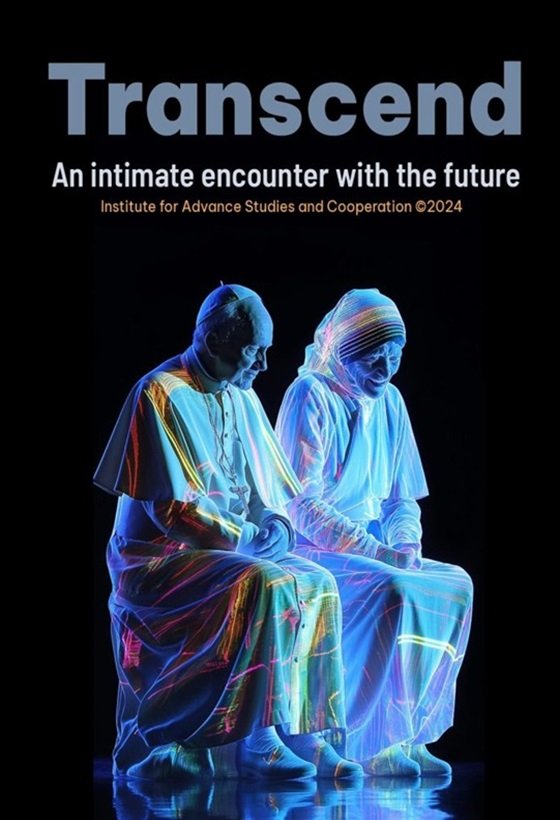
I believe that there is no definitive recipe for success in this endeavor. It is imperative that we always uphold the values of good faith and ethics as our guiding principles. We must express gratitude to the Higher Power who has bestowed upon us the gift of free will, the capacity to make choices, and the resilience to confront our fears with courage in order to surmount obstacles. As humans, it is our duty to serve, recognizing our uniqueness as individuals while acknowledging our interconnectedness with the collective whole. Our cherished Church functions as a sophisticated adaptive system inhabited by individuals of varying influence; some will leave a lasting legacy, while others may fade into obscurity. Regarding the proposed creation of two responsive avatars embodying the personas of Mother Teresa of Calcutta and Saint John Paul II, I understand the apprehensions that some may hold about this endeavor, fearing it may be perceived as a misguided attempt to resurrect these revered figures. However, I assure you that this undertaking is far from a fantastical aspiration akin to Frankenstein’s vision. The essence of this project does not lie in recreating beings that have passed but aims to meticulously craft avatars that embody the essence of the lives, missions, and teachings of these revered individuals. It is crucial to distinguish our intent of research and homage from the ill-conceived notion of attempting to replicate these Saints through a human lens. Our dedicated efforts are focused on developing two avatars capable of engaging in meaningful dialogue by drawing from the authentic speeches delivered by these remarkable individuals during their time on Earth. These avatars are designed to provide insightful responses to the inquiries posed by the faithful in a manner befitting the nature of the questions presented.
 Gabriele Andreoli, technology, and specifically artificial intelligence, is it good or bad?
“It depends on how it is used. We certainly would not want to use technology for things that are offensive, but let’s go back to the idea that it is humans who have the responsibility and free will to use these means. The only way for choices that stem from this human freedom to be ethical is to teach people what they are doing and what they are using. In fact, if dictatorships put weapons in the hands of young people, they themselves become deadly weapons because they do not have the ethical capacity to understand what life is, as they are manipulated and influenced to use these weapons ruthlessly. This argument also applies to technology. If we do not assume the responsibility to work to share technology, this same technology can also become malign. I like to reflect and I would like everyone to reflect on the fact that the embrace of St. Peter, by Bernini, to humanity tells us precisely that the Church is present for a great embrace of sharing. In fact, I do not understand how we can separate our faith from what we do.”

